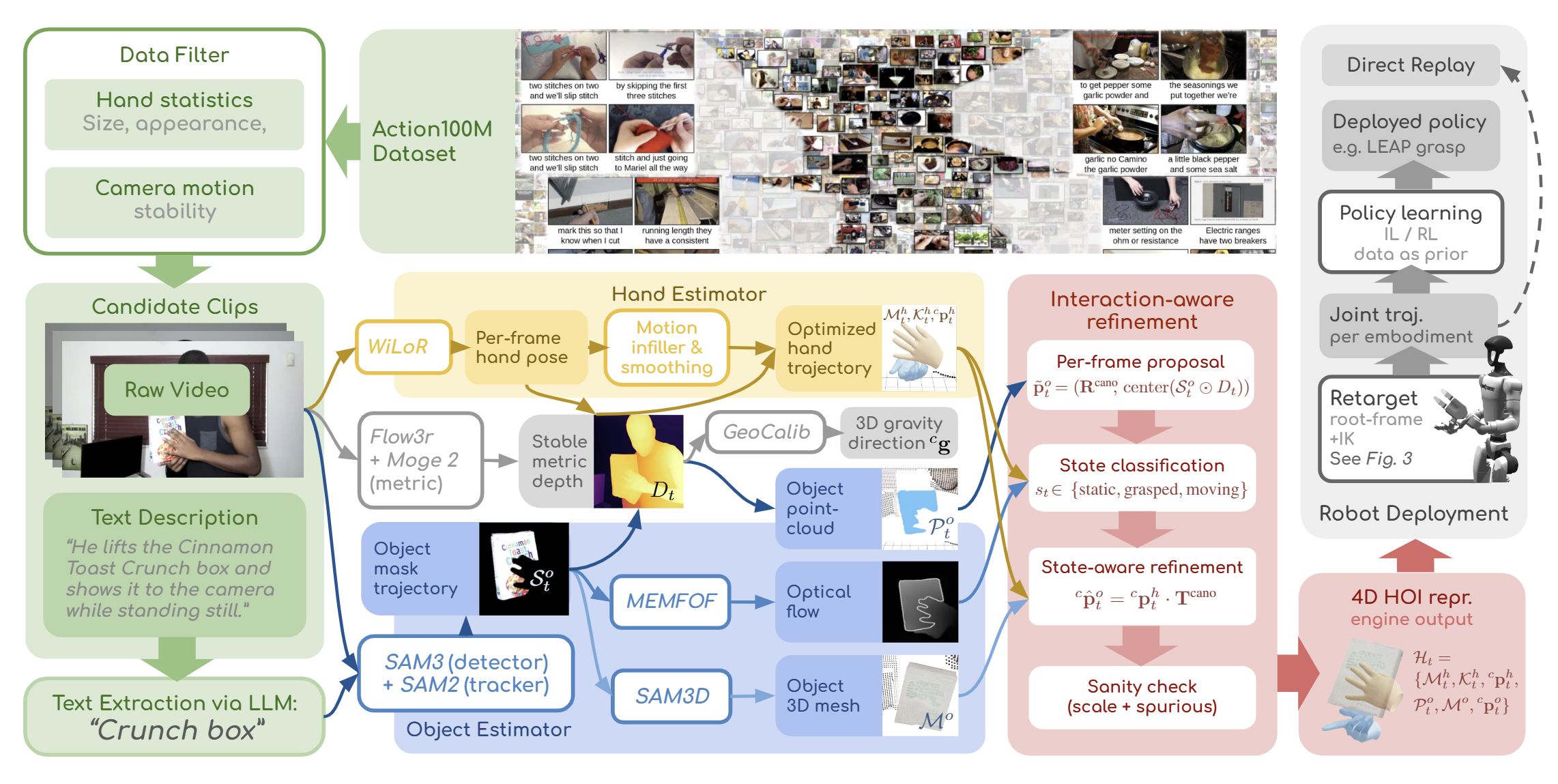
EgoInfinity turns filtered in-the-wild Action100M clips and their text descriptions into metric hand trajectories and object geometry and pose, then retargets the recovered motion onto diverse robots and real hardware.
01 / Overview
Abstract
Internet videos are the largest reservoir of embodied human manipulation knowledge, yet converting arbitrary RGB footage into actionable robot training data remains a major bottleneck. Lab- and factory-collected datasets are narrow in scale and diversity, limiting open-world robot learning.
Instead of releasing a static dataset, we introduce EgoInfinity, a universal 4D hand-object interaction data engine for web-scale data generation. It is a modular engine that integrates perception, segmentation, reconstruction, interaction-aware refinement, and retargeting to automate the video-to-action problem with no human-in-the-loop annotation, and it keeps improving as any one component is upgraded.
EgoInfinity lifts in-the-wild human manipulation videos into agent-agnostic, metric 4D representations: hand trajectories, 6-DoF object poses, and contact-relevant states. Rather than naively connecting standalone components, it combines cross-module metric calibration with interaction-aware refinement to reduce the drift and contact inconsistency common in pure visual reconstruction. A novel functional retargeter then compiles the recovered 3D hand motion into executable joint trajectories for diverse robot morphologies, enabling video-to-action transfer on any robot from arbitrary viewpoints and shot sizes, even when the human body is only partially visible. We validate EgoInfinity across perception fidelity, kinematic feasibility, contact consistency, cross-embodiment generalization, and real-robot skill acquisition (grasping, cutting, wiping, and pouring).
14.6yr
addressable corpus (≈127K hr)
0annot.
no wearables / mocap / CAD / manual labels
4robots
embodiments retargeted
2real
real platforms (Franka FR3 · LEAP hand)
Scale is currently bounded by Action100M (14.6 years of footage across 147M action segments); the engine itself is corpus-agnostic. The interactive demo hosts a curated subset of 106 processed clips.
02 / Pipeline
The data engine
A modular pipeline that lifts monocular RGB video into a metric, agent-agnostic 4D hand-object representation.
Engine overview. From filtered clips and text descriptions, the engine recovers metric hand trajectories and object geometry and pose for automatically discovered objects; an interaction-aware refinement stage aligns hand and object motion and suppresses drift.
A lightweight two-pass strategy keeps web-scale processing tractable. Pass 1 scans for hand-present segments and filters clips by hand-motion statistics and camera-motion stability. Pass 2 runs the full reconstruction stack only on the retained active segments. EgoInfinity currently targets approximately static-camera footage, common in tutorial and how-to content.
Metric geometry & calibration
MoGe-2
Camera focal length and global metric scale: the metric anchor that the hand and object predictions are then calibrated into.
monocular metric geometry
Flow3r
Dense per-frame depth for back-projection, temporally aligned against a static-background template.
dense depth
GeoCalib
Single-image gravity direction, giving an up-axis shared by hands, objects, and the ego view.
gravity / camera calibration
Hand reconstruction
WiLoR
Per-frame MANO hand parameters (21 joints, 778 vertices); the MANO root is rescaled into metric units against the depth.
RGB hand reconstruction
HaWoR infiller
A ~35M-parameter Transformer (HaWoR) completes missing or unstable hand frames; biomechanical limits and quaternion-space smoothing remove jitter.
infill + smoothing
Object discovery, reconstruction & tracking
SAM 3
Open-vocabulary detection driven by the clip's text description, so the manipulated object is found without manual annotation.
concept detection
SAM 2
Streaming mask track (forward and backward) over the full clip; masks are lifted with depth to per-frame point clouds.
segmentation / tracking
SAM 3D Objects
Canonical object mesh from the cleanest unoccluded frame, with a canonical orientation and metric scale.
object reconstruction
FoundationPose++
6-DoF object pose trajectory in the same metric frame as the hands, with stabilization for weakly observed frames.
6-DoF pose tracking
MEMFOF
Dense optical flow used to separate static-background from dynamic pixels and to classify per-frame interaction state.
optical flow
Not a naive stack: cross-module calibration + interaction-aware refinement
Hand and object predictions come from different models and are not inherently aligned in scale or reference frame. EgoInfinity calibrates them into a shared metric camera frame, then refines object motion using detected interaction states. Each frame is classified as static, grasped, or moving (a finer six-state label is used internally): a grasped object is rigidly bound to the hand frame, a static object is locked to its robust point-cloud centroid, and a moving object keeps its smoothed per-frame proposal. Lightweight sanity checks suppress implausible scales and flag spurious background detections. This is what cuts the drift and contact inconsistency seen in pure visual tracking.
The engine output is a metric, agent-agnostic 4D hand-object interaction state, scrubbable along the timeline and ready for downstream retargeting and learning:
hand mesh Mhhand keypoints Khhand pose SE(3)object point cloud Poobject mesh Moobject 6-DoF poseinteraction state
Egocentric view synthesis: the engine's namesake
The exo-to-ego conversion is a rigid reframing of the recovered 3D scene, not a 2D generative translation, so it never hallucinates pixels. A virtual ego camera is placed above the bilateral hand midpoint, its up-axis set to the gravity vector and aimed at the interaction region, following it frame by frame. Source clips that share no common capture viewpoint are thus unified into a consistent egocentric observation while metric geometry and contact are preserved exactly.
03 / Method
Cross-embodiment retargeting
Functional transfer: preserve task-relevant hand motion within a robot's constraints, without copying human arm or body kinematics.
Root-frame estimator. Recovered 3D hand trajectories and gravity feed a simulation-trained, robot-specific root estimator; the best candidate root frame is selected, and motion is retargeted through IK and post-optimization.
Arbitrary internet videos often show only the hands, partial arms, or changing viewpoints, so exact body-pose recovery is unreliable. Instead of imitating kinematics, EgoInfinity estimates a feasible robot-specific root transformation and preserves task-relevant hand motion within the target robot's limits.
A SE(3)-equivariant estimator built from Vector Neuron layers predicts the root frame so that rigidly transforming the input transforms the prediction accordingly. It is formulated as a flow-matching generator over plausible root frames, capturing the ambiguity of partial-body observations, and is trained entirely in MuJoCo simulation per robot (about 1.5 to 2 hours each on a single RTX 3060), with augmentations for tracking noise, occlusion, gravity dropout, and rear-facing cameras.
At inference, sliding-window hypotheses are clustered into K=5 representative candidates under an SE(3) geodesic metric, then scored by IK convergence, residual tracking error, manipulability, joint-limit margin, and smoothness. The best candidate anchors a smoothed per-frame root trajectory; arm joints follow wrist-level IK targets while finger joints are mapped directly from MANO keypoints for dexterous hands.
04 / Validation
Experiments
Cross-embodiment retargeting
For each robot, the retargeter estimates a root transformation and solves IK to convert recovered 3D hand motion into executable joint trajectories under the robot's kinematic constraints. Dataset-level statistics:
Robot
IK rate
Pos. error
Ori. error
Jnt.-limit margin
Manipulability
Smoothness
Unitree G1
0.821
2.86 cm
6.73°
0.619 rad
0.012
0.00693
Robonaut2
0.774
6.67 cm
8.25°
0.134 rad
0.058
0.00343
Dual-Franka
0.706
10.27 cm
12.17°
0.572 rad
0.080
0.00582
IK rate: per-frame IK success rate. Pos. / Ori. error: mean hand position (L2, cm) and orientation (geodesic, °) between IK target and achieved pose. Jnt.-limit margin: mean minimum joint clearance (rad). Manipulability: mean index sqrt(det(J Jᵀ)). Smoothness: mean squared joint velocity. A single recovered 4D trajectory also compiles onto XLeRobot in simulation.
Real-robot skill execution
Retargeted motions are replayed on a real dual-arm Franka FR3, demonstrating functional execution across distinct manipulation tasks.
Cut
Pour bowl
Pour glass
Wipe box
Wipe computer
Downstream grasping policy
Beyond direct replay, EgoInfinity-extracted hand motions serve as priors to train a grasping policy on a real LEAP dexterous hand, generalizing across object shape.
Left to right: apple, banana, tomato can.
05 / Scope
Limitations
Approximately static camera. EgoInfinity excludes body-mounted or hand-held footage, which keeps web-scale processing tractable and avoids online SLAM but limits corpus diversity. The modular design can adopt SLAM-aware depth as those models mature.
Coarse contact. Interaction-aware refinement gives grasp detection and spatially correlated hand-object motion, but does not guarantee exact fingertip placement, force consistency, or no-slip constraints, and provides no tactile observations.
Robot-specific, functional retargeting. The retargeter may need retraining or calibration for a new robot and targets functional motion transfer rather than fine-grained kinematic imitation.
06 / BibTeX
Citation
@article{wang2026egoinfinity,
  title   = {EgoInfinity: A Web-Scale 4D Hand-Object Interaction Data Engine
             for Any-View Robot Retargeting and Video-to-Action Robot Learning},
  author  = {Wang, Gaotian and Ren, Kejia and Morgan, Andrew and Chen, Yiting
             and Qian, Howard H. and Chanrungmaneekul, Podshara and Hang, Kaiyu},
  journal = {arXiv preprint arXiv:2606.17385},
  year    = {2026}
}
If you use these statistics, please also cite Action100M, the source corpus.
Page layout adapted from the Nerfies project page, skinned with the EgoInfinity theme. Content licensed under CC BY-SA 4.0.